How to Verify Information and Spot Falsehoods
The first thing you need to do when you see a piece of information is to pause and think. Where did this come from? Who is making this claim? Then, you need to see if anyone else is reporting the same thing—specifically, sources you already trust. A quick reverse image search is another great trick to see where a picture originally appeared.
This simple, three-part mindset is your best defense against the wave of information you face every single day.
## Why Verifying Information Is a Modern Superpower
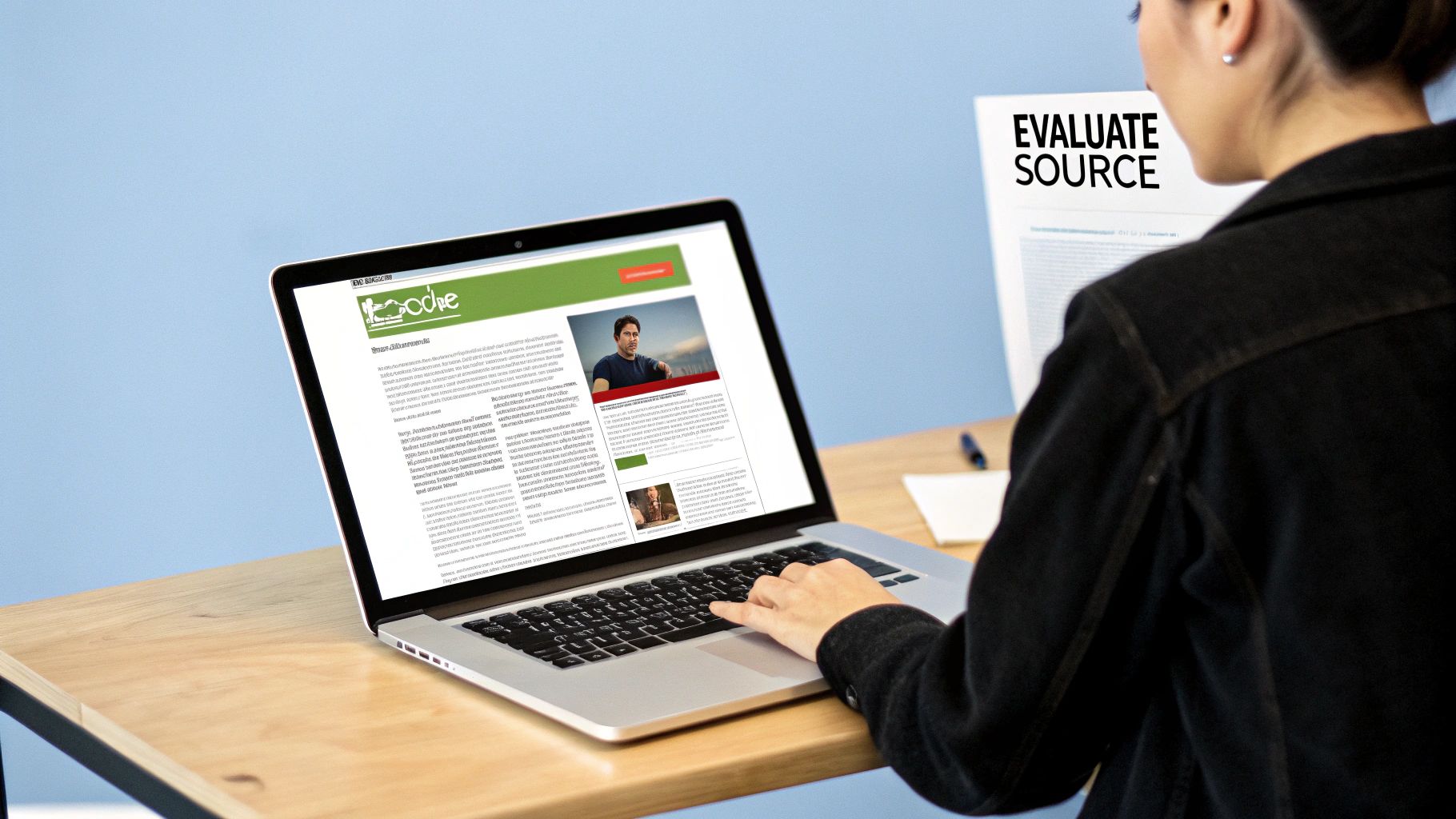
Let's be honest, we're all swimming in information. The ability to tell what’s real and what's not has become a crucial life skill. This isn't just about calling out "fake news" on your social feed. It’s about making smarter choices in every part of your life.

Think about it. Whether you're researching a major financial investment or trying to understand a new health guideline, the quality of your decisions depends entirely on the quality of your information.
The stakes have gotten incredibly high. With so many critical parts of our lives moving online—from banking to healthcare—we can't afford to be casual about data. One bad statistic or a cleverly tweaked image can cause real harm.
### The Growing Demand for Truth
This hunger for reliable information has kicked off a massive industry. The global Information Verification Market was already worth around **$11.85 billion in 2023** and is on track to hit nearly $22 billion by 2032. That's a huge jump.
What's driving it? A desperate need for accuracy in fields where trust and regulations are everything. AI and cloud tools are making verification faster and easier, which you can [read more about here](https://www.precedenceresearch.com/information-verification-market).
Getting good at this is like building a muscle. It takes practice, a bit of healthy skepticism, and knowing the right moves. You have to start thinking like a detective for the data you consume.
> **Key Takeaway:** Verifying information isn't about being cynical. It’s about being a critical thinker who asks for the receipts before buying into a claim.
### Core Principles of Information Verification
Before we get into the nitty-gritty methods, let's cover the basic principles. These are the foundational ideas you should apply to pretty much any piece of information that comes your way. Think of this table as your mental checklist.
| Principle | What It Means | Why It Matters |
| :--- | :--- | :--- |
| **Question the Source** | Who made this and why? Is it a known news outlet, a biased group, or some random account? | The source is everything. Knowing the creator's potential bias, expertise, or agenda is your first clue to its credibility. |
| **Look for Evidence** | Does the claim have any backup? Look for data, quotes from experts, or links to original studies. | Big claims need solid proof. Without it, you're just looking at someone's opinion, not a fact. |
| **Cross-Reference Claims** | Never trust a single source. See if other independent, credible outlets are saying the same thing. | Corroboration is king. If multiple reliable sources are reporting a story, you can be much more confident it's true. |
| **Analyze the Presentation** | Check the tone, grammar, and overall feel. Over-the-top headlines, emotional language, and tons of typos are all red flags. | Sketchy sources often try to manipulate your emotions because they don't have the facts to convince you. |
Once you start internalizing these principles, you'll develop a kind of automatic filter for information. Now, let’s get into the practical tools and strategies to put this all into action.
## Investigating the Source Like a Pro

Before you even start picking apart the claims in an article, your first move should always be to put the source itself under the microscope. A slick website or a confident author bio can be deceiving. The real story is usually hiding just beneath the surface, and knowing how to find it is a fundamental part of verifying information.
This isn't just about a quick glance at the "About Us" page. It's about becoming an active investigator. You have to ask the hard questions and approach every source with a healthy dose of skepticism until it earns your trust.
Imagine you stumble upon a financial blog making a bold prediction about the stock market. The site looks sharp, complete with professional-looking charts and a slick logo. But who's really behind it? What's their track record? And most importantly, do they have a vested interest in you believing their prediction? Asking these questions is what separates a passive reader from a sharp, critical thinker.
### Digging Beyond the Obvious
The first layer of your investigation should always be the author and the publication. Who are they, really? A quick search for the author's name along with their field of expertise can tell you a lot.
Are they a recognized expert with a long history of credible work? Or do they have a reputation for spreading questionable information? Look for their credentials, other places they've published, and what other experts in their field have to say about them.
Next, turn your attention to the publication. Is it a well-established institution with clear editorial standards, or a new site that seemed to pop up overnight? A great tactic I use is to search for the publication's name followed by terms like "bias," "funding," or "corrections." This can quickly uncover potential conflicts of interest or a pattern of having to retract stories. A "health research institute" that's entirely funded by a company selling a specific supplement, for example, has an obvious bias.
> A source’s history is incredibly revealing. A publication that regularly issues corrections and clarifications is often more trustworthy than one that never admits a mistake. It shows they're actually committed to getting it right.
### Uncovering Ownership and Agendas
Sometimes, the most critical information is deliberately buried. This is where you might need to get a little more technical, but you don't need to be a tech wizard to do it. One of the best methods is to find out who owns the website's domain name.
A simple [WHOIS lookup](https://www.whois.com/whois/) can often reveal the name and contact info of the person or organization that registered the site. While many owners use privacy services these days, you can usually still see when the domain was created. A website making sweeping historical claims that was only registered last week is a massive red flag.
Think about how official sources operate. Government agencies like the Social Security Administration and the IRS have to go to incredible lengths to verify identity because the stakes are so high. For its **1.9 million** flagged returns in 2024, the IRS sends specific letters and uses secure online portals to confirm a taxpayer is who they say they are. This is the kind of rigor that separates a trusted institution from an anonymous blog.
When you're investigating a source, here are a few practical steps to take:
* **Look for a physical address and phone number.** Real organizations are typically easy to contact. A lack of contact info is a bad sign.
* **Search for retractions.** A simple search like "[Publication Name] retraction" can show you if they have a history of getting things wrong.
* **Investigate their funding.** Non-profits and think tanks often list their major donors. Follow the money to see who's paying the bills.
* **Analyze their language.** Is the tone objective and professional? Or is it emotional and clearly designed to provoke a reaction?
For instance, a news story about a medical breakthrough should be reported calmly and cite peer-reviewed studies. If it's loaded with exclamation points and urges you to "act now before it's too late," it's probably more interested in getting your clicks than giving you facts. Building this habit of investigating the source is the foundation of effective information verification. It transforms you from a passive consumer into an active, critical thinker.
## Master the Art of Lateral Reading and Cross-Referencing

When a surprising bit of information pops up on your screen, what’s your gut reaction? Most of us stay right where we are, digging into the page, looking for clues to see if it *feels* trustworthy. It's a natural instinct. But professional fact-checkers do the complete opposite.
Their first move? They leave the site.
This simple but powerful technique is called **lateral reading**. Instead of drilling down into a single source, you pop open new browser tabs to investigate the source itself. It’s a game-changer because it shifts your focus from analyzing the *content* to evaluating the *container* it came in.
Think of it this way: a single source is just one witness at the scene. No matter how convincing they sound, you can't be sure you're getting the full story. Lateral reading is how you find other witnesses to either confirm or challenge that initial account.
### Why You Should Never Skip Cross-Referencing
Lateral reading’s main goal is to cross-reference claims against multiple, independent, and high-quality sources. This is how you build a sturdy web of evidence instead of putting all your faith in one place. Real verification isn't about finding one source that agrees with you; it's about finding a consensus among sources you can actually trust.
Let's say you stumble upon an article claiming a new "superfood" can reverse the aging process. Someone reading vertically might be impressed by the glossy photos and scientific-sounding jargon.
A lateral reader, however, is already opening new tabs. They’d search the superfood's name along with terms like "study," "evidence," or "scam." They're on the hunt for reports from major health organizations, university research centers, or respected medical news outlets. If the only other sites backing up the claim are blogs that just happen to be selling the same product? That’s a massive red flag.
> **Expert Tip:** When you cross-reference, don't just count the number of sources saying the same thing. The *quality* and *independence* of those sources are what truly matter. Three articles from outlets owned by the same parent company don't count as three separate sources.
### Let's Walk Through a Real-World Example
Imagine you see a tweet with a jaw-dropping statistic: "**80% of small businesses fail due to poor marketing.**" The tweet links to a blog post from a digital marketing agency. The post looks professional, but that number just feels off.
Here’s how you’d tackle this with lateral reading:
1. **Leave the site.** Don't get lost in their sales pitch. Your first move is to investigate the statistic itself, not their article about it.
2. **Search the core claim.** Head to your search engine and try a few queries, like "small business failure rates," "top reasons businesses fail," or "small business statistics."
3. **Look for the experts.** Prioritize results from government bodies like the [Small Business Administration (SBA)](https://www.sba.gov/), major financial news sources like Bloomberg or Forbes, and academic studies.
4. **Compare what you find.** You’ll quickly see that trusted sources like the SBA and the Bureau of Labor Statistics report that roughly **20%** of businesses fail in the first year and **50%** fail within five years. And while bad marketing can hurt, the most cited reasons for failure are cash flow issues, no market need, and a flawed business model.
In just a few minutes, you've discovered the truth. The agency likely twisted a statistic to make their services seem indispensable. By consulting more reliable and unbiased sources, you saw right through it.
### Building Your Web of Evidence
The more you find the same information repeated across diverse and credible sources, the more confident you can be.
* **One Source:** An unverified claim. It's just a starting point.
* **Two Independent Sources:** Now we're seeing a pattern. It's worth a closer look.
* **Three or More Reputable Sources:** This is strong corroboration. You can now be reasonably sure the information is solid.
This approach turns you from a passive reader into an active investigator. By refusing to take any single source at face value, you build a more accurate picture of reality, shield yourself from misinformation, and ultimately make much smarter decisions.
## Your Toolkit for Digital Verification
While sharp critical thinking is your best defense, a few trusted tools can really speed up the process of sniffing out fakes. Knowing which tool to pull out for the job is a skill in itself, and it's a key part of learning how to verify information like a pro.
One of the oldest tricks in the book is using images out of context. I’ve seen it a thousand times: a photo from a protest that happened five years ago gets passed off as a current event to stir up outrage. This is where a good reverse image search comes in handy.
### Finding a Photo's True Origin
My go-to for this is TinEye. It’s built for one thing and does it brilliantly. Instead of typing in words, you feed it an image, and it scours the web to show you where else that picture has appeared. More often than not, this leads you straight to the original source and the date it was first posted online.
The interface is dead simple—you can upload an image or just paste in the link.

Its simplicity is what makes it so powerful. In a single click, you can get a full history of an image and see if it’s being used to pull a fast one.
This simple check can dismantle a false story in seconds. For instance, if a "breaking news" photo of a wildfire is actually a still from a movie set, the whole claim just crumbles. It’s an incredibly quick and effective first step.
### Consulting the Professional Fact-Checkers
When you're up against a complex claim or a fishy-looking statistic, it's time to call in the experts. Professional fact-checking sites are your best bet.
These organizations do the heavy lifting for us. They’re transparent about their methods, always linking back to the primary sources they used to come to their conclusions. This means you can follow their work and judge their reasoning for yourself, which is a huge plus.
> **Expert Tip:** Don't just glance at the final rating, like "Mostly False" or "Pants on Fire." The real gold is in the full analysis. The evidence, context, and detailed explanation are where you’ll find the most valuable insights.
To help you choose the right service, I've put together a quick comparison of some of the most reliable tools out there. Each has its own strengths, so it's good to know which one to turn to for different situations.
### Essential Verification Tool Comparison
| Tool Name | Primary Use | Best For |
| :--- | :--- | :--- |
| **[Snopes](https://www.snopes.com/)** | Debunking viral myths & urban legends | Checking those "too good to be true" stories and internet rumors. |
| **[PolitiFact](https://www.politifact.com/)** | Vetting political claims & statements | Verifying what politicians and public figures are saying. |
| **[FactCheck.org](https://factcheck.org/)** | In-depth analysis of political discourse | A non-partisan look at the factual accuracy of U.S. politics. |
| **[TinEye](https://tineye.com/)** | Reverse image search | Tracing the origin of a photo to see if it's being used out of context. |
Having these bookmarked can save you a lot of time and help you get to the bottom of a claim much faster.
### The Bigger Picture: The Rise of Identity Verification
Beyond just checking articles and photos, there's a whole industry dedicated to verifying that people are who they say they are. This has become crucial for fighting sophisticated fraud online.
Think about it—this is the professional side of information integrity. The global identity verification market was valued at **$9.87 billion** in 2022 and is expected to shoot up to **$33.93 billion by 2030**. This massive growth is all about securing digital transactions and meeting tough regulations like **Know Your Customer (KYC)**. Companies are now using AI to confirm identities with incredible accuracy. You can read a full breakdown of these trends in this [Grand View Research report](https://www.grandviewresearch.com/industry-analysis/identity-verification-market-report).
While you might not need an AI-powered system to check a news article, you can adopt the same meticulous mindset. By combining a healthy dose of skepticism with these practical digital tools, you build a powerful system for sorting fact from fiction.
## Outsmarting Your Own Cognitive Biases
Let's be honest: the hardest part of spotting bad information often has nothing to do with the source. The real challenge? It's us. Our own brains are wired with mental shortcuts, known as cognitive biases, that can lead us astray.
These shortcuts help us navigate a complex world without getting overwhelmed, but they also create some serious blind spots. And when it comes to misinformation, they can make us our own worst enemy.
The biggest culprit here is **confirmation bias**. We all have it. It’s that natural, almost gravitational pull toward information that proves we were right all along. If you're convinced a new diet trend is the real deal, you’ll instinctively click on articles that praise it and scroll right past the ones from registered dietitians debunking it.
It feels good to have our beliefs validated, so our brains work overtime to protect that feeling. Getting past this isn't easy and requires a conscious effort to question what we *want* to be true.
### Actively Look for Disagreement
So, how do you fight back against your own brain? The single best tactic is to deliberately seek out smart people who disagree with you.
Don't just look for more evidence to back up your gut feeling. Go on the hunt for credible, well-argued counterpoints.
For example, say you're excited about a new marketing software that promises amazing results. Your first search was probably something like, "reviews for [Software Name]." Now, your next search needs to be "problems with [Software Name]" or "[Software Name] vs [Competitor Name]." This forces you out of your echo chamber.
> The goal isn't just to be open to the idea you might be wrong. It's to be genuinely curious about *how* you might be wrong. That curiosity is your strongest shield.
This feels weird at first. It’s like you're intentionally trying to poke holes in your own great idea. But building this habit is the only way to get a complete, balanced picture. You'll either find the flaws in your original thinking or strengthen your position with a much deeper understanding of the topic.
### How to Keep Yourself in Check
You can’t just switch off your biases. They're baked into our human wiring. But you can learn to spot them in the wild and manage them before they take the driver's seat.
Here are a few practical ways to stay objective:
* **Play Devil's Advocate:** Before you fully buy into a claim, force yourself to argue against it. What are the most compelling points the other side would make? This little mental debate is great for spotting weak spots.
* **Imagine You're Wrong:** Ask yourself, "What would it take for me to change my mind on this?" If the answer is "nothing," that's a huge red flag that bias is in control.
* **Hit the Brakes:** Misinformation loves to ride the wave of a strong emotional reaction. If a headline makes you angry, giddy, or scared, that's your signal. Pause. Take a breath. Think before you click share.
Mastering this kind of thinking is what separates a casual reader from a truly critical thinker. It’s how you build a powerful, internal defense system against being fooled—not by some scammer, but by the person in the mirror.
## Making Verification a Lifelong Habit
Knowing how to check facts isn't just about winning an argument online. It's about building a healthy, lifelong habit that gives you a real sense of clarity and control in a world flooded with information. This isn't a one-time checklist. Think of it more as a mindset—one built on a foundation of patience, a healthy dose of skepticism, and genuine curiosity.
Every time you pause to question a source, cross-reference a claim, or even just check your own biases, you're strengthening your critical thinking skills. Over time, it becomes second nature. It's like an automatic filter that helps you sort fact from fiction with confidence.
This skill has become absolutely essential. The market for identity verification services is exploding—valued at **USD 13.8 billion** in 2024 and expected to climb to **USD 46.4 billion** by 2033. This isn't just about corporate security; it shows how vital verification has become in every part of our lives, from banking to social media. You can dive deeper into the trends driving this growth in [this detailed market report](https://www.imarcgroup.com/identity-verification-market-statistics).
### How to Talk About Misinformation Without Starting a Fight
Let's be honest: one of the hardest parts of this is talking about a false claim with friends or family. It can feel like walking on eggshells. The secret is to approach the conversation with empathy, not accusation.
Instead of bluntly saying, "You're wrong," you'll get much further with a gentler, more collaborative approach.
> Try asking something like, "That's an interesting point. Where did you see it? I'd love to take a look." This simple question opens a door to a conversation instead of slamming it shut. It shifts the focus from the person to the source of the information.
From there, you can suggest looking at other sources together. Frame it as a team effort to find the real story, not a lecture on what they *should* believe.
### A Simple Plan for Daily Practice
The goal here is to feel empowered, not overwhelmed. By turning these small actions into habits, you're not just protecting yourself from bad information—you're helping create a more informed and thoughtful community.
Here’s a simple way to make this a part of your daily routine:
* **Pause Before Sharing.** If a headline makes you feel a strong emotion—anger, excitement, or fear—that's your signal to stop and verify before you hit share.
* **Get Curious.** Make it a habit to wonder, "Is there another side to this story?" Turn it into a personal challenge to find different, credible viewpoints on the topic.
* **Lead by Example.** When you do share something, casually mention that you checked it against a few other sources. This is a powerful, subtle way to model good habits for your network.
Making this a habit transforms you from someone who just consumes information into someone who actively and responsibly shapes it. It’s a quiet superpower in today's noisy world, and it brings a welcome sense of clarity and control.
## Common Sticking Points in Verification
Putting these verification skills into practice is where the rubber meets the road. Even seasoned researchers run into tricky situations that don't have a simple, clean answer. Let's walk through a few of the most common hurdles you'll likely encounter and how to navigate them.
### What If a Claim Is Brand New?
You stumble upon a shocking claim, but nobody else seems to be reporting on it yet. This is a classic "breaking news" dilemma. My best advice? **Patience**.
The first wave of information in a developing story is often chaotic and filled with errors. It's far better to wait for credible, established news outlets to do their own digging than to run with the very first report. Let them sort through the noise first.
### What If a Source Mixes Facts with Opinion?
This is a subtle but incredibly common tactic. An article might present perfectly accurate data points but then weave them into a narrative that supports a heavily biased conclusion.
Your job here is to carefully pull the two apart. Acknowledge the factual information they're presenting, but then question their interpretation. Are they leaving out key context? Are they making logical leaps? The facts might be true, but the story they're telling with them might not be.
### What If All the "Good" Sources Disagree?
You've done your due diligence, checked multiple reputable sources, and they're all saying different things. This doesn't mean the truth is unknowable; it just means the topic is complicated.
When you find conflicting information, it's time to become a detective. Start asking *why* they disagree.
* Are they using different data or studies?
* Do they define their terms in slightly different ways?
* Is one report more current, reflecting new developments?
Often, the disagreement itself tells a deeper story. Understanding the nuances behind the conflict is a hallmark of truly advanced verification work.
> **Key Insight:** Don't expect perfect consensus on complex issues. Your goal isn't always to find one simple "truth," but to grasp the different credible viewpoints and the evidence that backs each one up.
### Can I Trust My Social Media Feed?
This is a big one. Can you ever really trust what you see on social media? At face value, the answer is almost always **no**.
Social media algorithms are built to maximize engagement, not to ensure accuracy. Even well-meaning friends and family can unknowingly share things that are completely false.
The safest approach is to treat everything on social media as a **tip**, never a conclusion. See an interesting post? Great. Now, take that claim *off* the platform and use the lateral reading and source-checking methods we've covered to see if there's any fire behind the smoke. This simple mental shift is your best defense against the flood of online falsehoods.
---
Ready to join a community actively working to separate fact from fiction? [**Factiii**](https://factiii.com) is a community-driven research platform where you can submit claims, share evidence, and collaborate with others to find the truth. Empower yourself with the tools to fight misinformation by visiting [Factiii](https://factiii.com) and becoming part of the solution.